Scot Dahms

Sort by: Default | Name | Price
  • Scot Dahms' "The Lost Conibear Letters: How One Canadian and the Animal Trap Company Revolutionized Trapping - Frank R. Conibear 1896 - 1988" Book
    $29.95
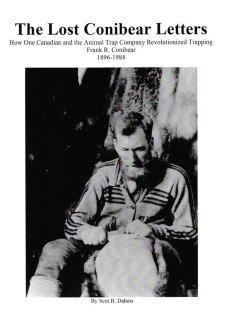
    Scot Dahms' "The Lost Conibear Letters: How One Canadian and the Animal Trap Company Revolutionized Trapping - Frank R. Conibear 1896 - 1988" Book focuses on Frank R. Conibear’s life from being part of the first white family in the Northwest Territories to his continuous improvements of his Conibear trap patents. Some may argue that Eric Collier played as much a role in the revolutionization of trapping with the Conibear trap and many of his articles and letters about the subject are included. Frank, the patent holder, was the main beneficiary of all funds made by the trap outside of the Animal Trap Company and was called upon to make all decisions as requested by them. This 395 page book uses many letters, memorandums, court cases and articles about the Conibear family and the legacy of the Conibear trap.
  • Scot Dahms' "Adirondack Dick:  The Illustrated Life of Richard K. Wood 1895 - 1977" Book
    $29.95
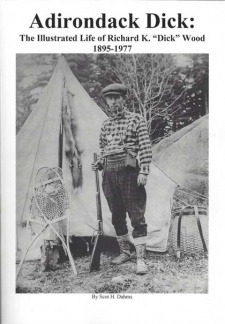
    Scot Dahms' "Adirondack Dick: The Illustrated Life of Richard K. Wood 1895 - 1977" Book was written in 2016 and is a wonderful look at the life of this old-time trapper. Wood trapped the Adirondack Mountains as well as areas in Tennessee, New York, Maryland and Virginia. Best known in the trap collecting community for his work with the Triumph Trap Company and his escapades with Elric J. "E.J." Dailey in the Adirondacks, Dick Wood also greatly influenced the outdoor writing and photography community. Early in his career, his articles mainly graced the copies of the Triumph Trap Company literature and the magazine called Fur News. Dick's articles told stories of his country wide trapping adventures and specifics on catching all types of furbearer species. This 310 page book is a compilation of Dick's stories and escapades written in his own words as much as possible. It contains many old black and white pictures. As you read through this book you will find comments made by Dick long ago which came true. Dick was a forward thinker, always busy with improving himself.
  • Scot Dahms' "Arnold Unknown:  The Complete, Untold Life of the Maine Legend Walter Lewellen Arnold 1894 - 1980" Book
    $29.95
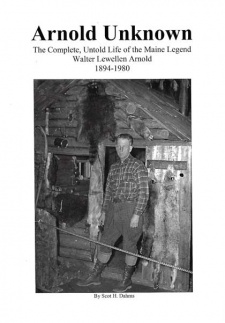
    Scot Dahms' "Arnold Unknown: The Complete, Untold Life of the Maine Legend Walter Lewellen Arnold 1894 - 1980" Book covers Walter’s life from cradle to grave, from his original birth certificate to his first article in the 1914 Hunter Trader Trapper, and finally, his last Holiday Greetings letter in 1980. If you want to know the legend from head to toe, this is the book for you. Although all know of Walter’s legacy of trapping, he was much more: author, logger, farmer, fisher, hunter, guide, gummer, pearler, bottle hunter, historian, biologist, carpenter, lover of wildlife, fur farmer, ginseng hunter, goat trapper, stamp collector, air raid warden, reemployment committeeman, veteran, veterinarian, game warden, photographer, city slicker, bait dealer, house cat owner, school trustee, stockholder and mostly a man of common sense and good humor. Although trapping is included in this 324 page book, Dahms' goal is to shed light on the other parts of Walter’s life. He was easily quotable, making common sense and poignant comments about all aspects of life. With all aspects of history, there are different points of view as to what happened when. This book is no different. Since Dahms was not there when these events happened, all he can do is write what he found and let you, the reader, determine what you want to believe or disregard. At times, Walter wrote conflicting information. Dahms contributes this to the passage of years and a memory that had the general thought of an event but may have lost the detail of time. Dahms wrote this book because of the connection Walter had to the Triumph Trap Company. If you have read his other books, you will know all have that connection. With Walter, he was a jobber selling many of their traps. Because he was a writer as well, he was able to use that platform to advertise Triumph Traps. In Dahms research, he found no one else referred to large sized Triumph Traps as much as Walter did. Walter often included references about the Triumph No. 415, No. 415X, No. 31X and No. 42X Ranger in his articles. There are many examples of those references. Parts of this book are written about practices from long ago. Many of these practices are illegal or not socially acceptable today. Dahms intent in including them is to show a picture of what the conditions were when Walter lived. Also, all towns are in Maine unless noted otherwise. Part of Walter’s legacy includes the contacts he made with numerous people through the course of his life. Included are several photographs of those people along with comments Walter made about them. Some of the photographs are of well-known trappers including EJ Dailey, Herb Lenon, Ed Danko, Pat Sedlak, V.E. Lynch, O.L. Butcher, Frank Terry, Oscar Cronk, Jim Mast and others. Walter also corresponded with other notable trappers including George Thiessen, Edwin F. Keith, John Kleffman, Ed Howe, Claude E. Marble, Raymond Thompson, Willie T. Harmon, Walter A. Gibbs, Frances E. Adams, Gene Hill and Pete Rickard. Walter’s trapping partners included his father, brother, Clifton McIntire, Adin Green, Bill Gourley, Walter Tozier, Stan Howland, Paul Stubbs Jr and Wendell Shaw. He was heavily influenced by his interaction with Margaret Brown Glassford, Howard Whiting, Charlie Temple and Robert and Terris Moore. He had many pets, mostly wildlife, with one exception – Berg, a farm cat. His wildlife pets included Elmer Gnawwood – the beaver, Chuck – the woodchuck, Harry and Harriet – woodpeckers, Susie – deer, Gentleman Jim – Susie’s son, Red Wing – Susie’s daughter and Red – the fox. Photographs in this book were taken long ago by Walter or others. Many had imperfections on them. Dahms did not try to enhance or repair the photographs as many were one of a kind. Over two hundred articles by and about Walter were researched for this book. From November 1961 to September 1964, Walter had a series of articles in Fur Fish Game titled “From the Deacon Seat.” The first one was in November 1961 with a continuation in December 1961. Chapter Two was in the July 1962 issue and Chapter Four was in the September 1964 issue. Dahms could not find Chapter Three in issues August 1962 to August 1964. Where space allowed, Dahms included photos of Walter’s Friends and customers throughout the book. Dahms also included Walter’s comments. This is just a small sample of the best photographs and comments. Walter was easily quotable, so Dahms started the book with a quote that will lay the groundwork. In 1977, Walter made the following comment. "I have farmed and trapped and guided and run trout hatcheries and bossed the river and run a trapper’s mail order business and written four books on trapping and lived in the woods. Mister, I like to do things."
  • Scot Dahms' "E.J. Dailey:  The Last Adirondack Trapper 1889 - 1973" Book
    $29.95
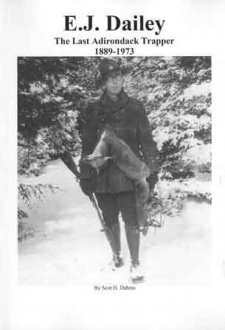
    Scot Dahms' "E.J. Dailey: The Last Adirondack Trapper 1889 - 1973" Book is a great read. This 300 page book was written in 2018 and is filled with historical black and white photos. E.J. Dailey was a trapper who lived in St. Lawrence County close to the Adirondack Mountains in New York State. During his life, E.J. was widely recognized as the foremost trapping expert. This book features reminiscences of him as a family man, trapper, partner, businessman, conservationist, professor and leader.
  • Scot Dahms' "Perfect Triumph:  Places, Faces and Cases of the Triumph Trap Company" Book
    $29.95
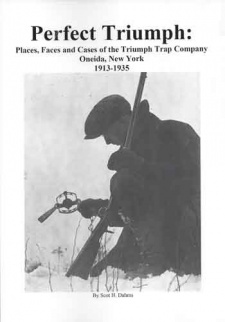
    Scot Dahms' "Perfect Triumph: Places, Faces and Cases of the Triumph Trap Company" Book presents the history of the Triumph Trap Company which was in business from 1913 - 1935 and was based in Oneida, New York. This book is 306 pages and contains 210 black and white pictures. It is filled with interesting historical information for those interested in the history of traps and trap manufacturing. The following is an excerpt from the book: "In the spring of 1913, Henry A. Constantine considered locating the new trap manufacturing company in Niagara Falls, New York and calling it the Niagara Game Trap Company. He inquired about manufacturing sites and studied the labor conditions. He found that a satisfactory site could not be obtained with real estate being very expensive. Available labor conditions were not satisfactory either. Constantine then visited Oneida and met with the president of the Chamber of Commerce, Thomas A. Devereux. Devereux presented the advantages of locating a manufacturing plant in Oneida. They included real estate being available for purchase at lower prices, lower rent, Oneida was free of labor disputes, and abundant labor experienced in trap manufacturing. Because of those reasons, the decision was made to incorporate under the name Oneida Game Trap Company instead of Niagara Game Trap Company. A site for the building of a factory could not be located. Constantine wanted to be located near the right of way of the New York Central and Hudson River Railroad or near the Ontario and Western Railroad. The major advantage of locating near a railroad was the convenience of shipping. He asked Devereux to help locate a site. Several locations were suggested but they either could not be purchased or were not suitable for a building site. Devereux suggested a possible location on the northerly side of the West Shore Railroad near that railroad’s freight station. It was formerly known as the Oneida Castle Station. This was the only satisfactory location that could be found for sale at the time. Constantine secured an option on the property and the option was later assigned to him making him the owner. Eugene F. Kitendaugh, Oneida Community Limited Legal Department, pointed out the interesting connection that all of the traps shipped out by Oneida Community Limited were under the Bill of Lading of Oneida Castle. The identical spot where the property was purchased. He said “if this scheme is carried out” both company’s shipments will have the same Bill of Lading out of the same freight depot. Kitendaugh believed the name of Oneida Game Trap Company and the location of the factory with a Bill of Lading of Oneida Castle out of the same freight depot as Oneida Community Limited was intentionally done to identify the new business as closely as possible with the business of Oneida Community Limited. Kitendaugh questioned whether this interaction with the president of the Chamber of Commerce even happened as Devereux would later be an attorney for the Oneida Game Trap Company. On May 10, 1913, Constantine received information from the officers of the Chamber of Commerce that it was possible to obtain manufacturing space in the building known as the industrial building located on James Street near the freight depot of the New York Central and the Hudson River Railroad Company. He entered into an arrangement with the owners to occupy part of the building for trap manufacturing and took possession on May 10, 1913. Thus began the tumultuous twenty two years the Triumph Trap Company was in business."
  • Scot Dahms' "Walter A. Gibbs:  Ohio Trains, Triumph Traps & Maryland Muskrats 1869 - 1941" Book
    $29.95
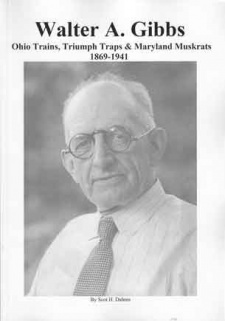
    Scot Dahms' "Walter A. Gibbs: Ohio Trains, Triumph Traps & Maryland Muskrats 1869 - 1941" Book contains lots of great historical information. This 300 page book was written in 2018 and is filled with historical black and white photos and diagrams. Walter A. Gibbs was a trapper and trap manufacturer in the early 1900's. He was not only instrumental in trap improvement but also in the knowledge of muskrat biology. He made in-depth research into muskrat breeding programs and farming. He also revolutionized the capture of live muskrats for shipping to other areas to restock areas lacking muskrats. His trap inventions allowed a large number of unharmed muskrats to be shipped worldwide. He developed many unique and important trap improvements. Many are still used today and were important to the modernization of traps and trapping techniques.